Stinging insect activity in Milwaukee County intensifies rapidly from late spring through early autumn, driven by seasonal shifts across microclimates near Lake Michigan. Yellow jacket queens emerge from overwintering…
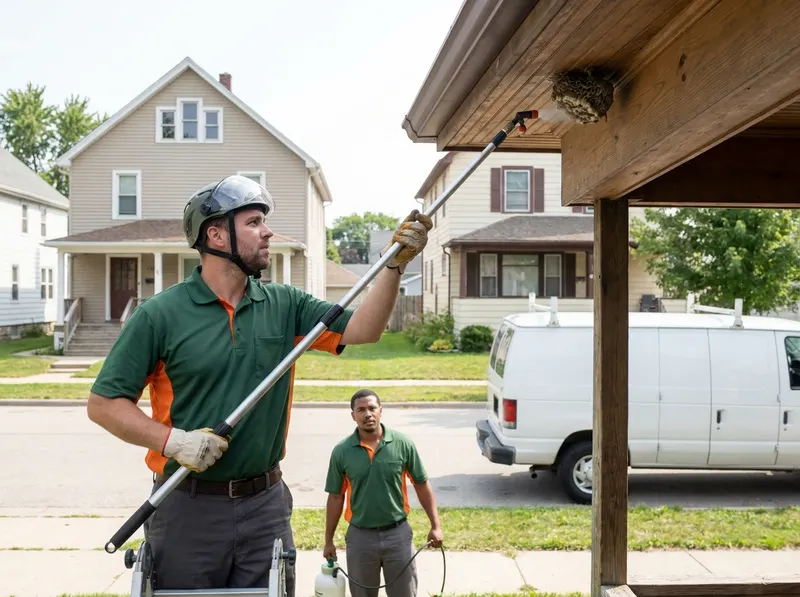
Stinging insect activity in Milwaukee County intensifies rapidly from late spring through early autumn, driven by seasonal shifts across microclimates near Lake Michigan. Yellow jacket queens emerge from overwintering sites in May to construct subterranean or wall-cavity colonies, while bald-faced hornets establish aerial paper nests in dense branch canopies around Lake Park and Riverside Park. In historic neighborhoods like Brewers Hill, Brady Street, and Washington Heights, architectural details such as unbacked soffits, loose cedar trim, and porous brick mortar joints provide direct voids for paper wasps. Addressing an active colony requires isolating the entry point without driving defensive foragers deeper into finished drywall spaces, finished basements, or living areas.
Treatment strategy depends on nest architecture and physical elevation. Exposed aerial colonies under bungalow porch eaves in Bay View or Walker's Point permit direct liquid aerosol knockdowns followed by physical detachment and scrapings to remove pheromone markers. Subterranean colonies common in Riverwest yards or Sherman Park garden beds require micro-encapsulated dust formulations injected under pressure directly into primary access tunnels, followed by a 24-hour monitoring period to eliminate returning foragers. If yellow jackets enter masonry weep holes or unsealed window flashings in the Historic Third Ward, treating the exterior void with non-repellent transfer compounds neutralizes the queen without causing indoor breakthrough through drywall or interior baseboards.
Structural protection relies on separating stinging insects from property voids rather than broad-spectrum outdoor spraying. Standard service covers immediate colony knockdown and physical scraping of all reachable paper or mud combs up to 20 feet high. For honey bees established inside interior framing, extermination gives way to extraction protocols or coordination with local beekeepers to prevent honey fermentation, mold development, and structural secondary infestations from carpet beetles. Structural repair of damaged eaves remains the homeowner's responsibility, but targeted exclusion work, such as expanding copper mesh packing and elastomeric caulking around utility chases, is integrated into the treatment to prevent seasonal re-infestation.
Every job gets a firm, written price after a free on-site visit.
Tell us about your wasp and bee removal job in Milwaukee and we'll send a clear, written quote, usually the same day.
 Rasteno Pest Specialists