Rodent control and exclusion addresses the physiological cause of infestations rather than relying on recurring bait programs. Norway rats (*Rattus norvegicus*) and house mice (*Mus musculus*) seek warmth as…
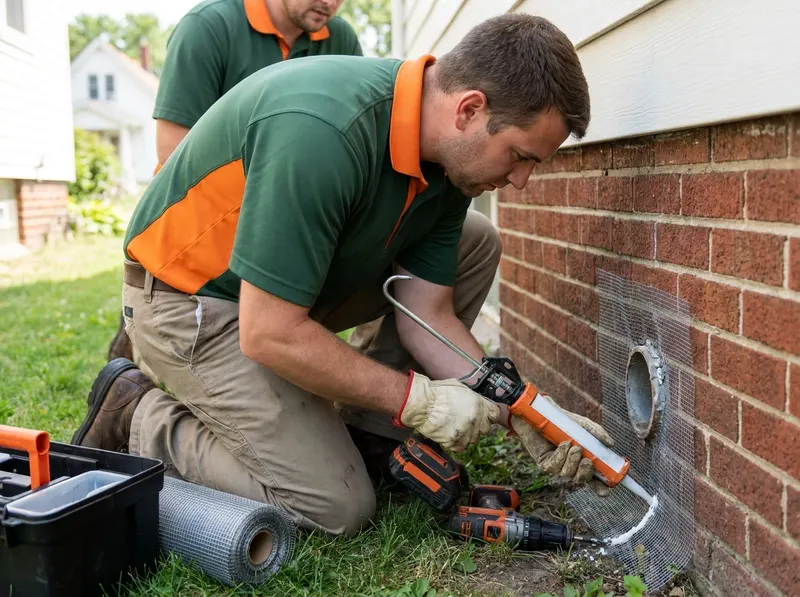
Rodent control and exclusion addresses the physiological cause of infestations rather than relying on recurring bait programs. Norway rats (*Rattus norvegicus*) and house mice (*Mus musculus*) seek warmth as temperatures drop along Lake Michigan between October and March. In neighborhoods like Bay View, Washington Heights, and Riverwest, Milwaukee bungalows and multi-family duplexes feature weathered cream city brick foundations, fieldstone basements, and aging wood framing around sill plates. A standard juvenile mouse enters through an aperture of only 1/4 inch, while an adult rat requires roughly 1/2 inch. Simply placing interior traps without mechanical sealing leaves a continuous scent path that draws neighboring rodents inside within days.
Targeted exclusion prioritizes perimeter defense over non-selective chemical dispersion. In historic duplexes throughout Brewers Hill and Sherman Park, plumbing stacks, disconnected dryer vents, and settling porch steps act as primary entry tunnels directly into hollow wall voids. Structural exclusion replaces interior rodenticides with heavy-duty physical materials: heavy 1/4-inch galvanized wire mesh, stainless steel escutcheon plates around pipe penetrations, and elastomeric sealants. This approach eliminates secondary poisoning concerns for household pets and prevents animals from dying inside inaccessible drywall cavities, which otherwise creates severe odor problems lasting 14 to 21 days.
Decision guidance depends on the structure's physical baseline. For multi-story properties along Brady Street or commercial conversions in the Historic Third Ward and Walker's Point, a targeted trap-and-seal approach is ideal if the active runway is confined to a single utility run or overhead loading bay door sweep. When foundation mortar is crumbling across a 1,500-square-foot perimeter or multiple additions meet an older slab, a full structural envelope exclusion is required. The trade-off is initial investment versus operational duration: interior trapping alone carries a lower upfront cost but requires perpetual maintenance, whereas a full mechanical exclusion incurs higher labor costs on day one to eliminate long-term baiting contracts entirely.
Every job gets a firm, written price after a free on-site visit.
Tell us about your rodent control and exclusion job in Milwaukee and we'll send a clear, written quote, usually the same day.
 Rasteno Pest Specialists